Showing posts with label design. Show all posts

Tuesday, June 1, 2010

Four Seasons: Eatin' Good In The Neighborhood

Being the talk of the town has never been a problem for F&B outlets within the Four Seasons Hotels & Resorts portfolio. Getting locals to actually step foot in those renowned restaurants has been a bit more challenging.

Recently, the company began rethinking the way it designs its restaurants, eschewing the trappings of classic luxury and embracing a more modern aesthetic. I talked with Guy Rigby, Four Seasons’ vice president of F&B for the Americas, about the company's new policy of commissioning designers exclusively for the restaurants. Today, Rigby tells me, “casual elegance” is the goal for Four Seasons' F&B projects, although the company is careful to consider local market factors, realizing that classic formal dining is still the expected rule in certain cities around the globe, like Hong Kong and Paris.

"In the good old days, most hotels would be designed by one good designer and, by definition, would do the guestrooms and spa and the restaurants and the common areas, and so the whole hotels would take on a very similar look," Rigby says. Four Seasons would then come in and install a certain theme in the restaurant that would "fit inside that box.”

At the end of the day, even though each Four Seasons restaurant was ostensibly unique, they tended to have one thing in common: they were inherently targeted primarily at the hotels’ guests. While Four Seasons restaurants have long been recognized the world over for their excellent cuisine and superb service, they often feel unapproachable among the locals. "The experience was fantastic, but we were lacking a little bit of buzz,” Rigby says.

The overarching restaurant trend in many cities over the past decade has been to offer fine dining and an adventurous culinary experience in a more casual setting. Rigby admits it was a dramatic shift in hotel F&B design that was a long time evolving but which Four Seasons was slow to embrace. "We realize the most important thing is that when our guests go to the concierge and ask, ‘Where do the locals eat?’ that [the answer] be a Four Seasons restaurant," he says.

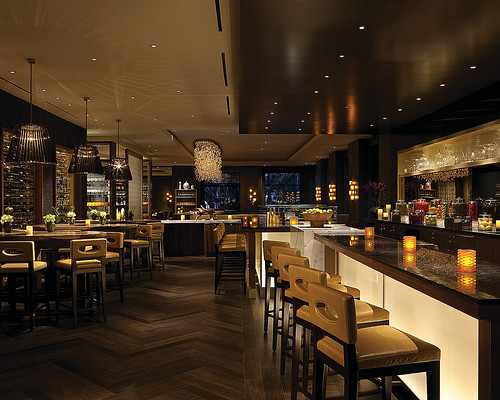
New Four Seasons restaurants, like the showpiece Culina Modern Italian (above) at Four Seasons Hotel Los Angeles at Beverly Hills, forego outdated, unwritten rules like keeping dining room and bar areas separate and hiding the kitchen and service stations. This may not sound revolutionary, but for a brand as steeped in traditional luxury as Four Seasons, it most certainly is. “We have to make sure the restaurants we build in our hotels are in tune with the great restaurants that are going up outside our hotels," Rigby says.

In rare instances, that even means partnering with a celebrity chef, like in the case of Michael Mina’s Bourbon Steak at Four Seasons Hotel Washington, DC. It also means making a concerted effort to moderate the sometimes eye-popping menu prices. "Our service has always been exceptional, but things like the quality of cutlery and stainless steel were getting out of hand,” Rigby says. “We don’t need to be charging US$85 for a hamburger; part of this creating a neighborhood restaurant is offering neighborhood pricing."

Here is a great slideshow of images from some of the newly concepted Four Seasons restaurants. Check out Aer at Four Seasons Hotel Mumbai, in particular. Very cool.

Friday, May 21, 2010

IHG Hires Student Designers For Fresher Perspective, Less Money

Candlewood Suites is getting a design makeover from the same group that gave its IHG sibling brand Staybridge Suites a guestroom refresh last year: SCAD.

No, SCAD is not a design firm. It is the Savannah College of Art and Design. The designers are students in the college's graduate-level interior design class.

I asked Rob Radomski, vice president of global brand management for IHG's extended-stay brands, why the company opted to turn to 20-something students rather than more seasoned professionals for such a major brand redesign project.

For one, he says the students bring a fresher perspective to design.

"We knew that we had to take a non-traditional approach, in order to get the results that we wanted, which were designs that weren’t what you’d typically find at an extended-stay hotel," Radomski tells me. "Partnering with SCAD gave us the opportunity to tap into the next generation of travelers, as I mentioned earlier, to see what they want when staying at a hotel. Some of these students had already spent time in the workplace, so they had experience staying at hotels, but they also had the knowledge about what’s next in terms of design trends. The students were very engaged with the project and had a unique energy that came through in the designs they presented."

Another factor is cost. The SCAD partnership saves IHG and its franchisees a lot of money compared to commissioning a design house. If the end result is just as good—and Radomski believes it might even be better in some respects—then why not?

"This frees up money, which we can use for other brand projects," he says. "Where the students can raise the value proposition even further is through their level of critical thinking. For instance, in the projects we’ve worked together on, they’ve demonstrated the ability to find meaningful cost savings through the use of different—and sometimes more sustainable—products and manufacturing processes. When our franchisees get ready to implement these designs, these sustainable products will save them money in the long run. Additionally, the students have a tremendous design sense, and we fully expect that guests will be willing to pay more for the designs they’re creating for us."

In the Staybridge redesign (left), Radomski credits the students with creating modern design elements that work for an extended-stay brand, namely components that address the need for personalization and storage.

"We have a desk hutch that frees up workspace on the desk and gives storage space for a guests’ office supplies, computer equipment, phone chargers, etc.," he says. "There are nesting tables that fit under the floating bedside tables that guests can use to sit down on and tie their shoes, or lay out their clothes in the morning or use as extra seating if needed. The students created ottoman cubes that have a removable top that can be used as a lap board, with space for storage inside. We also have customizable shelves in the closets, since some guests will need to bring more shoes or clothing, for instance, if they’re staying for a longer period of time."

The students are to present their final design concepts for Candlewood later this month, and the Candlewood brand team will then work with the concepts to come up with workable final designs.Model rooms are expected to begin construction in the fall.

Pantone Hotel Opens; When Will Someone Open A Font Hotel?

Finally, graphic designers and production editors have a haute hotel they can call their own.


The Pantone Hotel opened this week in Brussels, featuring modern design decked out in just seven very precise dominant colors: Pantones 478, 200, 137, 1215, 238, 353 and 298. For those of us less accustomed to the famed color-matching system, that would be approximately brown, crimson, orange, beige, lavender, seafoam and aqua. And yes, you can select your room by color.

Pantone, in case you're baffled at this point, is a company that specializes in color precision, making sure graphic designers get the exact shades they're looking for. Why they would theme a hotel around this is a separate question, one that shouldn't obfuscate the concept's general awesomeness.

Naturally, the hotel's lounge serves colorful cocktails including the Pink Champagne Pantone 12-1107, the Lemon Drop Pantone 12-0736 and the Daiquiri Green 12-0435.

The 59-key hotel offers free WiFi. A room for tonight costs a very reasonable €59.